 In our last post, we talked about what happens when a business with an immediate-eligibility Solo(k) hires its first employee. In short, that employee may become eligible for the plan right away.
So, once an employee is part of the plan, what actually changes?
Quite a bit. Not because anything has gone wrong, but because the plan now has to operate as a 401(k) with employees. Those responsibilities are completely normal; they may just feel new when you have been running an owner-only plan up to this point.
Payroll Becomes A Bigger Part of the Retirement Plan
With an owner-only 401(k), contributions can be fairly straightforward. The owner decides how much to contribute, coordinates with the CPA or advisor, and deposits the money into the plan. Once an employee is eligible to make 401(k) deferrals, payroll becomes a much bigger part of the process.
The employee needs to be given the opportunity to make a deferral election, and payroll needs to know whether – and how much – to withhold from each paycheck. Those amounts then have to be deposited into the plan and allocated to the employee’s account after each paycheck date.
Both traditional and Roth 401(k) elective deferrals are made through payroll deductions, so this is one area where “we’ll figure it out later” is not a particularly viable operating procedure.
Your Investment Provider Needs to Be Ready Too
This is one of those details Solo(k) owners may not think about until they hire someone. Not every Solo(k) provider is set up to support a plan with employees. In fact, many are not.
The investment provider may have been a perfectly good fit when the plan consisted of one owner account. Now, however, the plan may need:
- Separate participant accounts
- Employee enrollment and education
- Contribution tracking
- Participant statements and disclosures
- Distribution processing
Qualified retirement plans come with ongoing recordkeeping, participant communications, and other administrative responsibilities. So, one of the first questions to ask is: “Can our current provider support the plan we have now?”
If the answer is no, the plan may need to move to a platform designed to support a traditional 401(k).
Testing May Enter the Picture
This is another big change. With no employees, an owner-only 401(k) generally does not have to perform nondiscrimination testing because there is no employee population against which the owner’s benefits need to be tested. Once an eligible employee enters the plan, that changes.
A traditional 401(k) is generally subject to annual nondiscrimination testing, including ADP and ACP testing when applicable, unless the plan qualifies for an exemption such as safe harbor treatment.
Why does that matter? Because the owner’s ability to maximize contributions may now be affected by what employees contribute. That can be an unwelcome surprise for an owner who has been used to contributing the maximum each year without having to think about anyone else’s deferral rate.
Then There Are Employer Contributions
Remember that immediate vesting provision? This is where it suddenly matters a lot more.
If the plan provides employer contributions, you need to determine whether the employee is eligible to receive an allocation and how that contribution should be calculated. And if the plan provides 100% immediate vesting, any employer contribution allocated to the employee is immediately nonforfeitable.
Provisions that barely warranted a second look when the owner was the only participant can suddenly become very important.
And Reporting Changes Too
An owner-only plan may only need to file Form 5500-EZ if total plan assets exceed $250,000. Below that threshold, there may be no annual filing requirement at all. Once employees begin participating, the reporting picture changes too.
The plan now generally takes on the broader reporting, disclosure and administrative responsibilities that come with a traditional employer-sponsored 401(k). Government filings and participant disclosures become part of the regular operating process.
Again, this does not mean the plan is in trouble. It simply means it can no longer operate as a Solo(k).
In a Nutshell
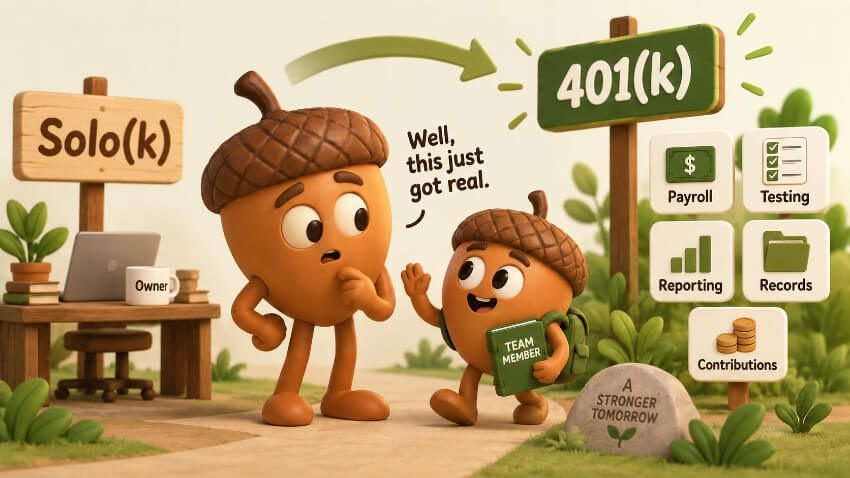
The first employee does not simply add another account to your Solo(k). That employee can change how the entire plan needs to operate. Payroll, recordkeeping, testing, employer contributions and reporting may all look different once an employee enters the picture.
That can sound like a lot, and it can become a lot if these issues are not addressed until after the first employee has been hired. When you plan for the change ahead of time, it can be a simple transition from an owner-only plan to a retirement plan designed for a growing business.
Which brings us to the next question:
Should you simply keep the old Solo(k) design, or is this the right time to build a better 401(k) for the business you have now?
We’ll tackle that in the next post.