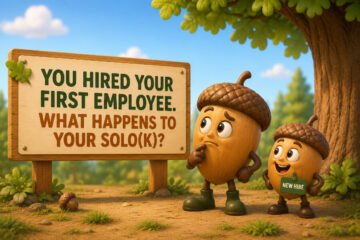
 Your business is growing and you have hired an employee. That’s a great reason to celebrate!
But if you have a Solo(k), that first hire can bring a few unwelcome surprises to the party.
Payroll needs to be updated. The employee may need an account. Someone needs to handle the administration and compliance testing. Get all of that taken care of and you’re good to go, right? Not so fast – there’s one more question worth considering:
“Does the retirement plan you designed when it was just you still make sense now that you have employees?”
Maybe it does, but I wouldn’t assume that without taking another look.
The Plan Was Designed for a Different Business
Think back to when you set up your Solo(k).
You were the only participant, so immediate eligibility was easy. There wasn’t anyone else waiting to get into the plan. Immediate vesting was a no-brainer too. You probably weren’t too concerned about yourself leaving the company six months later and taking the employer contribution with you. And if you wanted to make a generous profit-sharing contribution, great. You were the only one receiving it.
Those provisions made perfect sense for the business you had then. Once employees enter the picture, though, the goals and the math can change dramatically.
That’s why bringing on your first employee – or better yet, before you hire – is a good time to do more than simply figure out how to administer the existing plan.
It’s the perfect time to ask whether you would design your plan the same way today.
Start With Employer Contributions
Let’s say you’ve been making a large profit-sharing contribution to your Solo(k) each year.
Once an employee becomes eligible, you can’t just assume you’ll be able to continue making that contribution just for yourself. The plan document, contribution formula and nondiscrimination rules all come into play, leading to a very practical question:
“How much are you comfortable contributing for employees in order to accomplish your own retirement goals?”
That’s a very different conversation than the one that was had when the business owner was the only person in the plan. And this is where good plan design can make a real difference.
The goal isn’t necessarily to contribute as little as possible for employees, or as much as possible. The goal is to understand the options and intentionally choose a design that works for your business.
Should Safe Harbor Be Part of the Conversation?
Possibly.
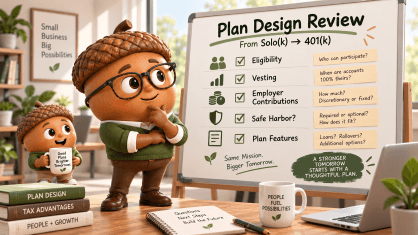
A traditional 401(k) plan is generally subject to ADP and ACP nondiscrimination testing. If that testing fails with the addition of a new employee, it can limit the amount the owner can now contribute. A properly designed safe harbor plan can avoid this problem and these tests, although it comes with its own employer contribution and plan requirements.
For an owner who wants to continue maximizing their 401(k) deferrals, such added predictability can be very appealing.
But safe harbor isn’t automatically the right answer just because an employee has been hired. There is a litany of questions to look at first, such as:
How many employees are there?
What do they earn?
Are they likely to participate?
All of these things can impact whether safe harbor provisions could be appropriate. That’s the difference between simply turning a Solo(k) into a regular 401(k) and actually designing a 401(k) for the business you have now.
What About Immediate Eligibility and Vesting?
Those deserve another look, too.
Maybe you like immediate eligibility and want to keep it. It can certainly be an attractive employee benefit. Or maybe, now that you’re hiring, you decide a different eligibility requirement makes more sense for future employees.
The same is true for vesting. Certain employer contributions in a traditional 401(k) can generally use an allowable vesting schedule rather than being immediately vested.
That doesn’t mean the answer is automatically to make the plan “less generous”. It simply means that these provisions should now be choices, rather than leftovers from a plan that was originally written for one person.
Timing is also key for these provision choices. Once an employee has earned certain rights or benefits under the plan, you generally can’t take them away just by changing the document later.
So, whenever possible, I’d much rather have this conversation before a new employee is hired than after the existing provisions already apply.
Let’s Take a Step Back From the Rules for a Minute
This is probably the most important part of the conversation.
Before deciding which plan provisions to change, ask what you want the retirement plan to accomplish.
Are you primarily trying to maximize your own retirement savings?
Do you want the plan to help attract and retain employees?
Do you want to offer a meaningful benefit without committing yourself to a large fixed employer contribution every year?
Would you like to reward employees who stay with the company longer?
Is flexibility important?
There isn’t one universal “right” answer, but there should be an answer that fits you and your company. The best retirement plan design starts with what the business owner is actually trying to accomplish, not with whatever provisions happened to be in the Solo(k) document.
In a Nutshell
Your first employee can radically change the administration of your Solo(k), and that is a good reason to take another look at the plan itself. The immediate eligibility, immediate vesting and contribution provisions that worked perfectly when you were the only participant may still be exactly what you want. Or they may not. The important thing is to make that decision intentionally.
Instead of asking “How do we turn my Solo(k) into a 401(k)?”
The better question is “Now that I have employees, what do I want my 401(k) plan to look like?”
That’s a much better starting point for the next stage of a growing business.
If your Solo(k) is about to become a little less “solo,” TNJ Retirement Partners can help you review the existing plan, understand what changes when employees are hired, and design a 401(k) that fits where your business is going, not just where it started.